
Air conditioning rules in Malta: outdoor units, façades
Three separate rule sets govern a home air-conditioning installation in Malta: the Development Notification Order on where an outdoor unit may go, the Condominium Act on who owns the wall, and the EU F-gas Regulation on who may legally handle the refrigerant.
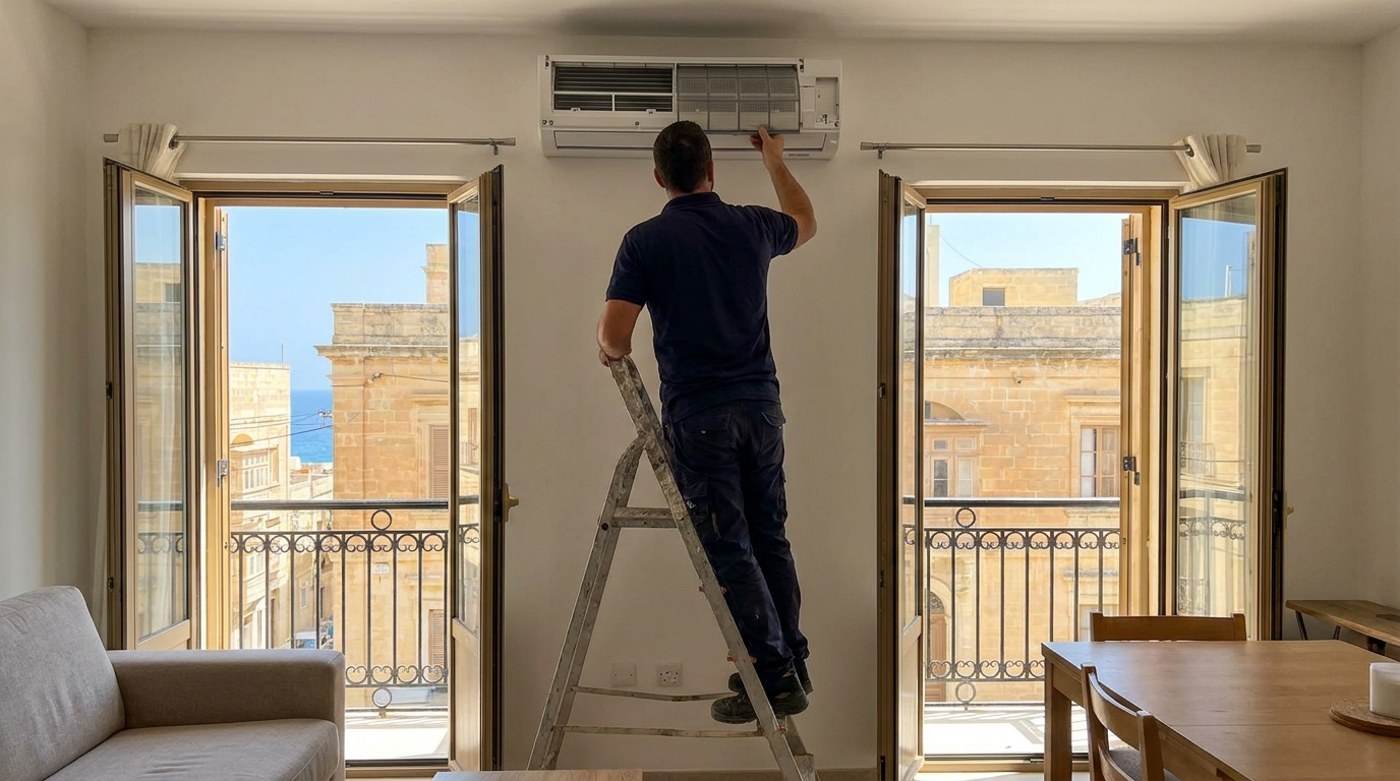
Three separate bodies of law touch a home air-conditioning installation in Malta, and they do not overlap neatly. Planning law decides where the outdoor unit may go. Condominium law decides whose wall it is going on. EU F-gas law decides who may legally open the refrigerant circuit. You can satisfy one and fall foul of another, so it is worth taking them in order.
Planning: the façade test
The Development Notification Order, S.L. 552.08, lists in its Schedule the classes of work that count as permitted development — things you may do without a full planning application. Class 2(ix) covers air-conditioning units.
The exemption carries one condition, and it is the whole of the Maltese planning question for most homes: the unit is permitted development unless it is located on any façade that faces a road or is visible from a road.
Note that this is two tests, not one. A façade that faces a road is obvious. "Visible from a road" is wider — a unit on a side elevation, a setback, or a roof parapet can be visible from a street it does not face. If either limb applies, Class 2(ix) does not cover the installation and the permitted-development route is closed.
In practice this pushes outdoor units towards internal shafts, rear yards, back elevations and recessed roof positions. That is a real engineering constraint rather than a formality: a shaft placement affects airflow, pipe run length, and how easily a technician can reach the unit for maintenance later. It is one of the first things we look at on survey, because it can change which indoor positions are practical.
The sources do not define how far from a road, or from which viewpoint, "visible" is judged. They also do not set out what you do instead when Class 2(ix) is unavailable. If your only viable position is street-visible, that is a conversation with the Planning Authority, not something this page can resolve for you.
Condominium: the wall is not yours
If you live in a block or a converted townhouse with separate titles, the Condominium Act, Cap. 398, matters more than the planning rule.
Art. 2 of the Act makes external walls, roofs and the airspace common parts. The wall outside your living room is not your private property merely because it adjoins your flat, and neither is the roof slab above the top floor unless your title says otherwise. Art. 8(3) requires unanimous consent of the condomini for alterations that change the aesthetics and decor of the building.
What the Act does not contain is any clause about air conditioners. It does not say that a condenser is an alteration of aesthetics and decor, and it does not say that you need consent to fit one. So the honest position is this: the surface you want to drill into is shared, the Act has a unanimity rule for aesthetic alterations, and whether a single outdoor unit engages that rule is not something the Act decides for you.
Check your condominium rules and your deed before you commit. Many blocks in Malta — particularly newer developments — carry rules in the deed of sale or the condominium regulations that assign specific condenser positions, reserve a service shaft, or restrict visible plant on the façade. Those documents are where the answer usually lives. Raising it at a condominium meeting before the installation is a great deal cheaper than removing a unit afterwards.
This bites hardest on shell-form purchases, which is how a large share of Maltese property is sold. You finish the interior yourself, so you choose indoor positions freely — but the outside wall you need for the condenser, and the shaft or roof run to reach it, were never yours to begin with.
F-gas: who may touch the refrigerant
Regulation (EU) 2024/573 applies directly in Malta. Art. 10 requires certification of both the persons carrying out work on refrigerant circuits and the companies employing them. A certified technician working for an uncertified firm does not satisfy the Regulation. In Malta the certifying authority is the MCCAA Technical Regulations Division — not ERA, which is frequently and wrongly cited for this.
Our technicians are CheckYourTraders-verified and F-gas certified. Where a job is better suited to a vetted partner, that partner contracts with you directly and you should apply the same check to them: certification for the individual and for the company.
Leak checks and records
Art. 5 sets leak-check intervals by the CO2-equivalent charge of the system:
| Charge (CO2 equivalent) | Check interval | With leak detection system |
|---|---|---|
| 5 to under 50 tonnes | 12 months | 24 months |
| 50 to under 500 tonnes | 6 months | 12 months |
| 500 tonnes or more | 3 months | 6 months |
A leak detection system is mandatory at 500 tonnes and above. Records must be kept for five years. These are charge-based duties, and the sources do not give a typical charge for a domestic split, so we will not tell you which band your flat's system sits in — your installer can calculate it from the nameplate.
The dates that matter
- 1 January 2026 — Art. 13(4): servicing or maintaining equipment with fluorinated gases of GWP 2,500 or more is banned. This affects older high-GWP equipment, not ownership of it.
- 1 January 2029 — Annex IV point 9: new single-split systems of 12 kW or less containing refrigerant of GWP 150 or more may not be placed on the market.
- 1 January 2035 — Annex IV point 9: new single-split systems of 12 kW or less containing any fluorinated gas may not be placed on the market.
Both phase-down dates apply to new equipment placed on the market. A compliant system you buy today does not become unlawful to own or to service in 2029.
Neighbours, noise and drips
This is where we have to be straight with you: none of the three sources sets a decibel limit for a residential outdoor unit, a minimum distance from a neighbour's window, or a rule about where condensate may discharge. We looked and found nothing. Anyone quoting you a specific national noise figure or drip rule for domestic AC should be asked which instrument it comes from.
What remains true regardless is physical: a condenser in a narrow shaft recirculates its own hot discharge and runs louder and less efficiently, and condensate has to be piped somewhere deliberate. Those are survey decisions, not legal ones.
Order of checks
- Identify a condenser position that is neither on a road-facing façade nor visible from a road — otherwise Class 2(ix) does not apply.
- Read your deed and condominium rules; the wall and roof are common parts under Cap. 398.
- Confirm F-gas certification for both the technician and the company under Art. 10.
- Check the refrigerant on the nameplate against the 2026 servicing restriction before buying second-hand or inheriting old kit.
One last point, because it is asked constantly: there is no Maltese grant for a residential split air-conditioning system. Budget on the full installed cost.
Common questions
- Do I need a planning permit to fit an air conditioner in Malta?
- Usually not. The Development Notification Order, S.L. 552.08, Schedule Class 2(ix), treats air-conditioning units as permitted development — but that permission does not apply if the unit is on a façade that faces a road or is visible from a road. If your only viable position is on a street-facing or street-visible elevation, Class 2(ix) does not cover you and you need to deal with the Planning Authority before the unit goes up.
- Can my condominium stop me putting a unit on the outside wall?
- The Condominium Act, Cap. 398, Art. 2 makes external walls, roofs and the airspace common parts — they are not your private property even if they adjoin your flat. Art. 8(3) requires unanimous consent for alterations that change the aesthetics and decor of the block. The Act contains no clause specifically about air conditioners, so we cannot tell you that consent is legally required for a unit as such. What we can tell you is that the wall is shared and that your condominium's own rules and deed may deal with it. Check them before you book an installation.
- Who is legally allowed to install and gas my air conditioner?
- Regulation (EU) 2024/573, Art. 10, requires both the individual doing the work and the company employing them to hold F-gas certification. The Maltese certifying authority is the MCCAA Technical Regulations Division, not ERA. Ask to see certification for the person and the firm before any refrigerant circuit is opened.
- Will my existing unit become illegal in 2029 or 2035?
- No. Annex IV point 9 of Regulation (EU) 2024/573 bans the placing on the market of new single-split systems of 12 kW or less containing refrigerant with a GWP of 150 or more from 1 January 2029, and any fluorinated gas in those systems from 1 January 2035. Those dates apply to new equipment only. Separately, Art. 13(4) bans servicing with fluorinated gases of GWP 2,500 or more from 1 January 2026 — that is a servicing restriction on older, high-GWP kit, not a ban on owning it.
What we could not establish
- Neither S.L. 552.08 nor Cap. 398 defines 'visible from a road' — no distance, sightline or viewpoint test is given, so borderline positions are a judgement call.
- The sources do not set a national noise limit in decibels for a domestic outdoor unit, nor a minimum separation distance from a neighbour's window or boundary.
- No rule on condensate discharge — drip onto a neighbour's property or the street — appears in any of the three sources. We found no DC15 or similar provision and will not invent one.
- The sources do not state the procedure, timescale or fee that applies when Class 2(ix) is unavailable because the unit would be visible from a road.
- Cap. 398 has no air-conditioning clause at all, so the Act does not tell you whether a single outdoor unit counts as an alteration of 'aesthetics and decor' under Art. 8(3).
- Regulation (EU) 2024/573 sets leak-check duties by CO2-equivalent charge, but the sources give no typical refrigerant charge for a domestic split, so we cannot state from them which threshold a given home system falls into.
Sources
- Development Notification Order, S.L. 552.08 — legislation.mt · read 2026-10-18
- Condominium Act, Cap. 398 — legislation.mt · read 2026-10-18
- Regulation (EU) 2024/573 on fluorinated greenhouse gases — EUR-Lex · read 2026-10-18
Drafted with Claude — claude-opus-5, then read, corrected and approved by Neil Bennett before publication. We do not publish anything a person has not read.
Want this costed properly?
The calculator gives you a figure in a minute. A site visit gives you a fixed price.
Book a free survey