
AC Gas Refill Malta: R32, R410A and Why the Leak Comes First
A domestic split does not use up its refrigerant. If it is low, it has leaked, and the leak is the job. This is who may legally touch the gas in Malta, what the F-gas Regulation requires, and which 2026, 2029 and 2035 dates apply to your unit.
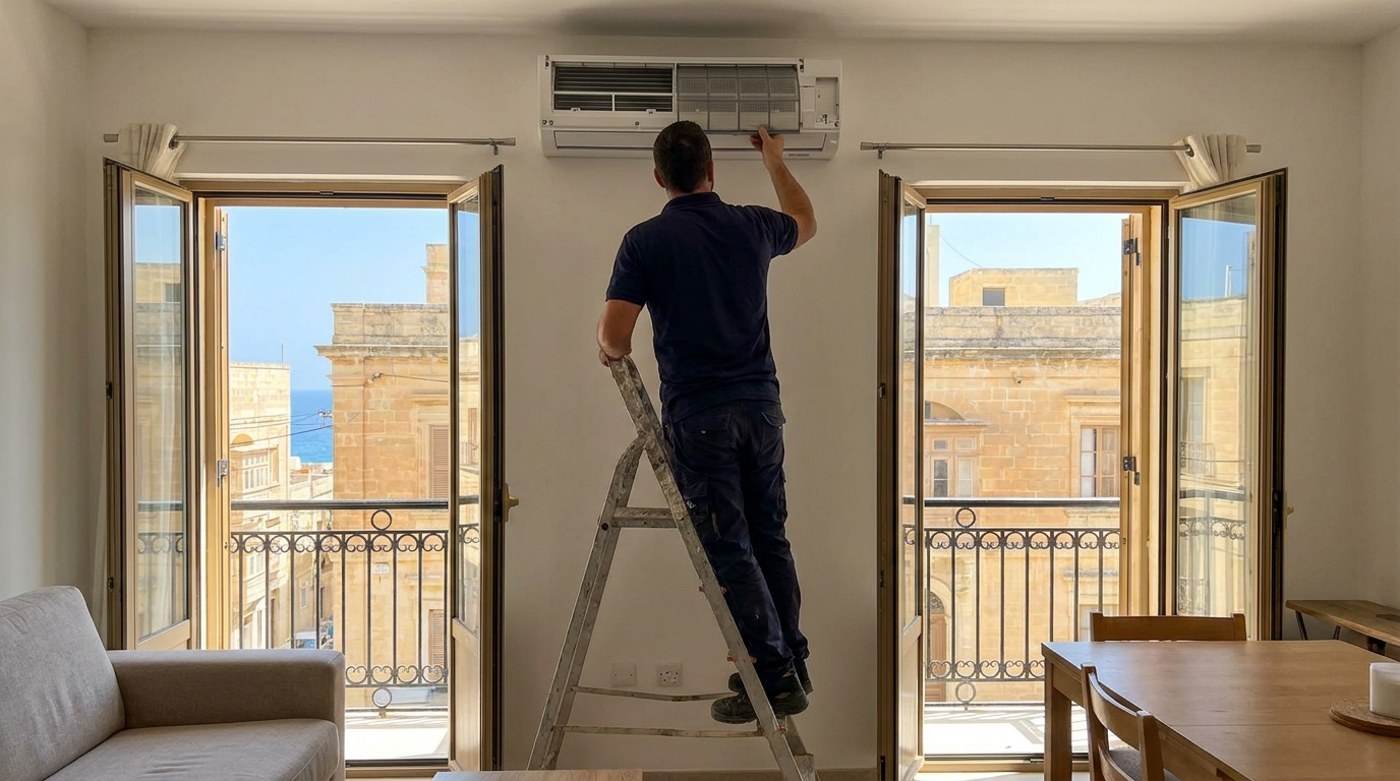
Almost nobody searches for "regas". People search for "AC gas refill", usually in July, usually because a unit that cooled the room last year now blows air that is merely less hot. The phrase is misleading, and the misunderstanding behind it costs Maltese homeowners money every summer.
Refrigerant is not a consumable
A split system is a sealed circuit. The refrigerant inside it circulates, changes state and circulates again. It is not burned, not used up and not due for replacement at intervals. Petrol is a consumable; refrigerant is not.
So there is only one reason a correctly installed split is low on gas: it has leaked. The usual suspects are the flare connections at either end of the pipe run, a chafed pipe where it passes through a wall, corrosion on the outdoor coil — which, on a Maltese roof or a seafront façade, is a real and fast process — or a joint that was never brazed or flared properly at installation.
That is why a competent visit starts with leak detection, not with a cylinder. Adding gas to a leaking circuit buys you a few weeks and vents the new charge to atmosphere afterwards. If someone offers to "top it up" without discussing where it went, you are paying for the same fault twice.
Who may legally touch the gas
Article 10 of Regulation (EU) 2024/573 requires certification of both the person and the company for activities involving fluorinated greenhouse gases, including leak checking, recovery, installation, maintenance and servicing. A certified technician working for an uncertified company does not satisfy the Regulation.
The upstream control matters just as much. Refrigerant is sold only to registered or certified buyers, and in Malta the authority that keeps that register is the MCCAA Technical Regulations Division — not ERA, which is frequently and wrongly named in forum posts. MCCAA publishes the list of companies registered to buy bulk gas. The practical consequence for a homeowner is simple: you cannot buy a cylinder and you cannot legally have an uncertified handyman charge your system. The gas does not reach him.
For our part, every job is surveyed by us. It is then delivered either by us as the contractor, with CheckYourTraders-verified, F-gas certified technicians, or by a vetted partner who contracts directly with you.
Leak checks and records
Article 5 sets mandatory leak-check intervals by charge size, measured in tonnes of CO2 equivalent rather than kilograms:
| Charge | Standard interval | With leakage detection system |
|---|---|---|
| 5 to under 50 t CO2e | 12 months | 24 months |
| 50 to under 500 t CO2e | 6 months | 12 months |
| 500 t CO2e or more | 3 months | 6 months |
A leakage detection system is mandatory at 500 tonnes and above, and records must be kept for five years.
Whether a household split falls into the first band depends on its factory charge and the GWP of its refrigerant, and the sources used here do not publish charge weights. Treat the table as the legal floor, not as a service schedule. A unit below the threshold is not exempt from physics: it still leaks, and an annual check is still how you find out before the compressor does.
R410A, R32 and R290
Three refrigerants cover almost everything you will meet in a Maltese home.
- R410A — the standard in splits sold through roughly the 2000s and 2010s. Many are still working. It runs at high pressure and is a blend, which means a leaked system should be recovered and recharged rather than topped up if you want it to perform as designed.
- R32 — the current mainstream for new residential splits. Single component, lower GWP than R410A, mildly flammable, and classified above the 150 GWP line that matters for the 2029 date below.
- R290 — propane. Very low GWP, well under 150, and highly flammable, which constrains charge size, siting and pipe runs. It appears mostly in monoblocs and some heat pumps rather than in conventional wall splits.
The two older-system questions we get asked — can my R410A unit still be serviced, and do I have to replace it — are answered in the next two sections, and the answer to both is no cause for panic.
1 January 2026: the GWP 2,500 servicing ban
Article 13(4) prohibits servicing or maintaining equipment with virgin fluorinated gases of GWP 2,500 or above from 1 January 2026. This is a real cut-off, but it does not catch ordinary domestic air conditioning: both R410A and R32 sit below that threshold. The gases affected are the high-GWP ones used mainly in commercial refrigeration — which, for a Maltese household, means the ban is relevant to a walk-in cold room, not to the split in your bedroom.
2029 and 2035: new equipment only
Annex IV point 9 of the Regulation sets the phase-down for splits:
- From 1 January 2029, new split systems of 12 kW or less containing fluorinated gases of GWP 150 or above may not be placed on the market. That removes R32 from new small splits.
- From 1 January 2035, new splits of 12 kW or less may not contain fluorinated gases at all.
Both restrictions apply to placing new equipment on the market. They do not require you to remove, replace or stop servicing a unit you already own. An R32 split bought in 2026 remains lawful to use and to maintain after 2029. What will change, gradually, is availability and price of the gas at the top of the market, which is a reason to fix leaks rather than live with them — not a reason to scrap working kit.
The Maltese details that decide the job
Apartments. Under Cap. 398 the external walls and the roof of a block are common parts. There is no air-conditioning clause in the law, so where an outdoor unit may be fixed, and whether a condemned unit may be moved to a better-ventilated spot, is a condominium question before it is a technical one. Get that settled before a technician arrives to diagnose a leak that turns out to need a pipe re-run.
Façades. Under the DNO, S.L. 552.08, Class 2(ix), an AC unit is permitted development unless it sits on a façade facing or visible from a road. Relocating a leaking outdoor unit to the front elevation is the kind of fix that creates a planning problem.
Shell-form homes. Where pipework was buried in the walls during finishing, a leak on the interconnecting line is the difficult case: locating it may mean pressure-testing sections and, in the worst outcome, running a new line surface-mounted in trunking. Say so at survey rather than discover it on the day.
Gozo. Equipment, cylinders and recovery gear cross on the ferry. A second visit is a second crossing, which is part of why diagnosis before parts matters more there.
What a straight answer looks like
If a technician tells you your system is low, three things should follow: where the gas went, what the repair involves, and what happens to the old charge — which must be recovered, not vented. If the answer to the first question is a shrug, you are buying refrigerant, not a repair.
Common questions
- Can I just have the gas topped up?
- A sealed split does not consume refrigerant, so if it is low it has leaked. A technician can add refrigerant, but unless the leak is found and repaired the charge will go again and the unit will keep running badly in the meantime. Ask for the leak to be located first; a top-up without a leak check is a repeat visit waiting to happen.
- Who is allowed to buy and handle refrigerant in Malta?
- Article 10 of Regulation (EU) 2024/573 requires both the individual technician and the company to hold certification for work involving fluorinated gases. In Malta the competent authority is the MCCAA Technical Regulations Division, not ERA, and it publishes the list of companies registered to buy bulk gas. Refrigerant is sold only to registered or certified buyers, which is why no one can hand you a cylinder to fit yourself.
- Is R410A banned from 2026?
- No. Article 13(4) bans servicing or maintaining equipment with virgin fluorinated gases of GWP 2,500 or above from 1 January 2026. R410A sits below that threshold, so an existing R410A split can still be serviced. The 2026 ban bites on higher-GWP gases used mainly in commercial refrigeration.
- Does my home split need an annual leak check by law?
- The mandatory leak-check intervals in Article 5 start at a charge of 5 tonnes of CO2 equivalent, with 12-monthly checks up to 50 tonnes, 6-monthly from 50 to 500 tonnes and 3-monthly at 500 tonnes or more, each interval doubling where a leakage detection system is fitted. Whether a particular split reaches 5 tonnes depends on its factory charge and the GWP of its refrigerant; the sources here do not tabulate charge sizes, so this has to be worked out unit by unit.
What we could not establish
- Neither source publishes a price for leak detection, repair or recharge in Malta, and we do not state one as a market fact.
- The sources do not give typical factory charge weights per kW, so they cannot be used to say whether a given domestic split crosses the 5 tonne CO2e leak-check threshold.
- The MCCAA list covers companies registered to buy bulk gas; it is not a quality ranking and does not record individual technicians' certificate numbers.
- Nothing in these sources sets a Maltese registration or logbook duty for household splits beyond what the EU Regulation itself requires.
- The sources do not set out installation or handling standards specific to R290 (propane) equipment.
Sources
- Regulation (EU) 2024/573 on fluorinated greenhouse gases — EUR-Lex · read 2026-10-18
- List of registered companies to buy bulk gas (Aug 2026) — MCCAA Technical Regulations Division · read 2026-10-18
Drafted with Claude — claude-opus-5, then read, corrected and approved by Neil Bennett before publication. We do not publish anything a person has not read.
Want this costed properly?
The calculator gives you a figure in a minute. A site visit gives you a fixed price.
Book a free survey