
AC not cooling? Checks to make before you call
Most 'no cooling' calls in a Maltese August are one of five things an owner can check in ten minutes. This sets out those checks, then the faults that legally and practically need a certified technician.
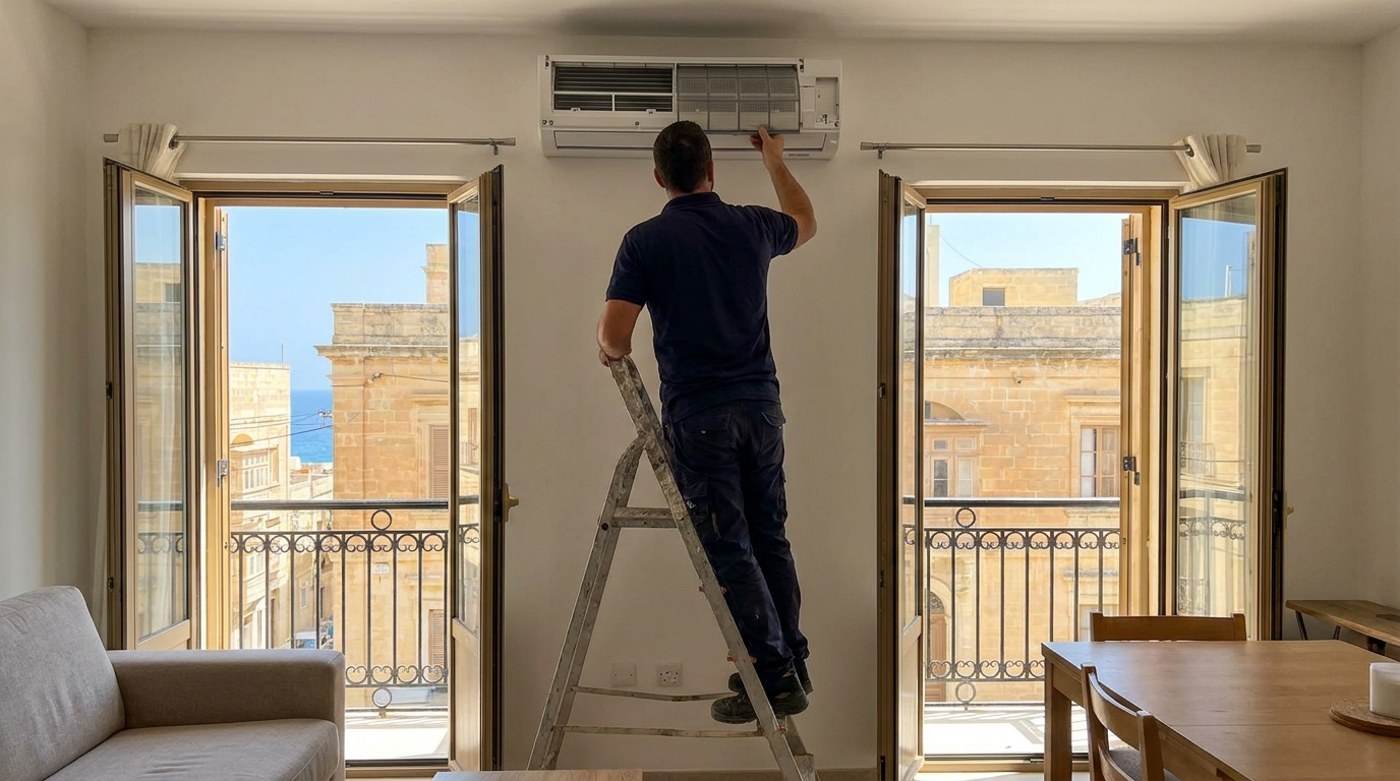
It usually fails in August. The unit that was fine in June is now running all day and the room is not getting any colder, and the first instinct is to phone someone. Ten minutes of checks first will either fix it for nothing or give the technician a much better starting point.
Some context for why the margin is so thin here. Eurostat put Malta at an average of 569 cooling degree days a year over 1979–2020, second in the EU behind Cyprus on 573. A cooling degree day is a measure of how much, and for how long, outdoor temperature sits above the point where cooling is needed. The practical consequence is that a Maltese split spends far more hours at full load than the same model in northern Europe, and that any loss of capacity — a clogged filter, a coil caked in salt and dust, a slow refrigerant leak — shows up as "it stopped cooling" rather than as a mild drop in performance.
The five checks to make first
Do these in order. None of them requires opening anything or touching the refrigerant circuit.
- Mode and set temperature. Confirm the remote is on cooling, not fan, dry or auto, and that the set point is below room temperature. Auto mode on some units will sit and do nothing in a narrow band. If someone else in the house changed it, or the remote was knocked, this is the single most common false alarm. Set it to 22 °C in cooling with the fan on high and give it ten minutes.
- Remote batteries. A remote with weak batteries can still light its own screen while failing to transmit. Replace them, point the remote directly at the indoor unit from a metre away, and listen for the confirmation beep. No beep means the indoor unit never received the command.
- Filters. Lift the front panel of the indoor unit and slide out the mesh filters. In Malta they load up with dust and, near the coast, salt. A blocked filter chokes airflow, the coil runs colder than designed, and you can end up with ice on the indoor coil and almost no air coming out. Wash them in lukewarm water, dry them completely, refit them. This is owner maintenance, not a service call.
- The outdoor unit. Go and look at it. It needs to breathe. Check for bags, boxes, bedding, a new pergola, a hanging plant, a washing line or a neighbour's clutter against the grille, and clear anything within roughly half a metre of the air intake and discharge. Note whether it sits in full afternoon sun against a south or west wall — an outdoor unit rejecting heat into air that is already radiating off masonry works much harder for less output. Listen: the fan should be spinning. If the fan is still and the compartment is hot, stop and call.
- The breaker. Find the circuit breaker for the AC at the consumer unit. If it has tripped, reset it once. If it trips again immediately or within minutes, leave it off and call. A repeatedly tripping breaker is a fault being reported, not a nuisance to be overridden.
If all five check out and the unit still will not cool, the fault is inside the machine.
What a technician is actually looking for
These are the causes that need tools, gauges and, for anything touching refrigerant, certification.
- Low refrigerant from a leak. A split's circuit is sealed. It does not use refrigerant up, so if it is low, there is a leak — commonly at the flare connections, at the service valves, or on the indoor coil. Symptoms include ice forming on the thin copper pipe at the outdoor unit, a long run time with weak cooling, and the compressor cutting out on its own protection. The repair is finding and fixing the leak, then recovering, evacuating and recharging to the nameplate weight. Recharging without repairing is money spent twice.
- Dirty condenser coil. The outdoor coil in Malta collects dust, salt and whatever the neighbours' airflow brings. A fouled coil cannot reject heat, head pressure rises, capacity drops and the unit may trip out in the hottest part of the afternoon. This is a cleaning job, not a parts job, and it is the one that most often restores a unit that "works in the morning but not at 3 pm".
- Failed fan motor or capacitor. A compressor or fan that hums but will not start, or an outdoor fan that stays still while the compartment gets hot, often points at a capacitor. These are mains-voltage components inside a live enclosure. Leave them alone.
- Sensor and control faults. Thermistors on the room air and the coil tell the board what to do. One reading wrongly makes a healthy machine behave as though the room is already at temperature. Error codes flashed by the indoor unit's LEDs are worth photographing before you call.
- Blocked condensate drain. Many units cut cooling, or flash a fault, when the drain backs up. The giveaway is water dripping inside before the cooling stopped.
The legal part, honestly
Anyone opening the refrigerant circuit on your unit is covered by Regulation (EU) 2024/573 Article 10, which requires certification of both the person doing the work and the company employing them. In Malta the competent authority for that certification is the MCCAA Technical Regulations Division — not ERA, whatever you may have been told. Asking to see F-gas certification before work starts is a reasonable question, not an insult.
Two other parts of the same Regulation matter to owners of older machines. Article 13(4) bans servicing with F-gases of GWP 2,500 or more from 1 January 2026, which affects some older equipment and makes repair of it a dead end. And Annex IV point 9 sets the phase-down dates — 1 January 2029 for new splits of 12 kW or less containing F-gases with GWP of 150 or more, 1 January 2035 for any F-gas in splits of 12 kW or less. Both dates govern new equipment placed on the market. Neither obliges you to replace a working unit. If you do choose replacement over repair, be aware there is no Maltese grant for a split air conditioner, so the cost is yours.
Article 5 sets leak-check intervals by charge size: 12 months for 5 to under 50 tonnes CO2e (24 months with a leak detection system), 6 months for 50 to under 500, 3 months at 500 and above, with records kept five years. Whether a given domestic split falls inside the smallest band depends on its charge, which is on the nameplate.
Apartments, shell finishes and Gozo
In a condominium, Cap. 398 makes the external walls and the roof common parts, and the Act has no air-conditioning clause of its own. Repairing a unit where it already stands rarely raises an issue; moving it, re-routing pipework across a façade or claiming roof space does, and that is a conversation with the condominium rather than with the technician on the day. If your flat was bought in shell form and the AC was fitted by whoever finished it, the pipe runs may not be documented — say so when you book, because tracing a leak in buried pipework is a different job from tightening a flare.
For Gozo, every part and every technician travels by ferry. Same-day attendance is harder to promise and a part that is not on the van means a second crossing.
Booking the visit
Have ready: the brand and model from the indoor unit's label, the year it was fitted if you know it, any error code the LEDs are flashing, which of the five checks above you have already done, and whether the outdoor unit is reachable without scaffolding. Details of the fault and the access are what turn a diagnostic visit into a fixed unit.
Jobs are surveyed by us. The work is then delivered either by us as contractor, with CheckYourTraders-verified, F-gas certified technicians, or by a vetted partner who contracts with you directly — you will be told which before anything is booked.
Full scope and what a repair visit covers: AC repairs. If the unit is down now, use the urgent repair form.
Common questions
- My unit blows cool air but the room never gets cold. Is it broken?
- Not necessarily. Malta averaged 569 cooling degree days a year between 1979 and 2020, second in the EU after Cyprus at 573, so a unit that was marginal for the room on the day it was fitted will fail to hold temperature in a heatwave even when it is working perfectly. Check for a dirty filter and a blocked or sun-baked outdoor unit first. If the unit is clean, running flat out and still losing ground, the question is sizing and heat gain, not a fault, and that needs a survey rather than a repair visit.
- Can I just have it topped up with gas?
- A sealed refrigerant circuit does not consume refrigerant. If it is low, it is leaking, and adding more without finding the leak means paying again later. Regulation (EU) 2024/573 Article 10 requires both the individual handling the refrigerant and the company employing them to hold certification, so this is not an owner task and not a job for an uncertified handyman. In Malta the certification authority is the MCCAA Technical Regulations Division, not ERA.
- Will the 2029 and 2035 F-gas rules force me to scrap my existing unit?
- No. The phase-down dates in Annex IV point 9 of Regulation (EU) 2024/573 apply to placing new equipment on the market. From 1 January 2029 new split systems of 12 kW or less containing F-gases with a GWP of 150 or more may not be placed on the market, and from 1 January 2035 that extends to any F-gas in splits of 12 kW or less. Nothing in those dates requires you to remove or stop using a unit you already own.
- The outdoor unit is on the block's external wall. Does that affect a repair?
- It can affect access and anything that changes the installation. Under Cap. 398 the external walls and roof of a condominium are common parts, and the law contains no specific air-conditioning clause, so the position depends on your deed and the condominium's rules. A straightforward repair in place is usually uncontroversial; relocating a unit, running new pipework across a façade or using the roof for a new position is a condominium matter and should be raised before the technician arrives.
What we could not establish
- Neither source establishes the typical refrigerant charge of a domestic split, so we cannot tell you which of the Article 5 leak-check intervals (5 to under 50 tonnes CO2e: 12 months, or 24 with a leak detection system) applies to your specific unit — the charge in kg is on the outdoor unit nameplate and the conversion depends on the refrigerant.
- Neither source lists the GWP of individual refrigerants, so you cannot work out from these documents alone whether the Article 13(4) servicing ban on F-gases with GWP of 2,500 or more, in force from 1 January 2026, catches your unit.
- Nobody in Malta publishes failure-rate data for domestic splits. The ordering of likely causes below comes from survey experience, not from a published statistic.
- There is no published market rate for a diagnostic call-out, a leak repair or a refrigerant recharge in Malta, and we do not quote one here as if there were.
- The two sources used here do not cover electricity tariffs. Enemalta bills residential consumption in rising annual bands, so a unit running far longer than it should costs more per kWh as well as more kWh — the band structure is printed on your own bill.
Sources
- Cooling degree days: Cyprus and Malta highest in the EU — Eurostat · read 2026-10-18
- Regulation (EU) 2024/573 on fluorinated greenhouse gases — EUR-Lex · read 2026-10-18
Drafted with Claude — claude-opus-5, then read, corrected and approved by Neil Bennett before publication. We do not publish anything a person has not read.
Want this costed properly?
The calculator gives you a figure in a minute. A site visit gives you a fixed price.
Book a free survey