
AC leaking water indoors? Causes and fixes in Malta
An air conditioner that drips indoors is almost always a condensate problem, not a refrigerant leak. Here is how to tell the difference, what to check before calling anyone, and where Maltese condominium rules come into it.
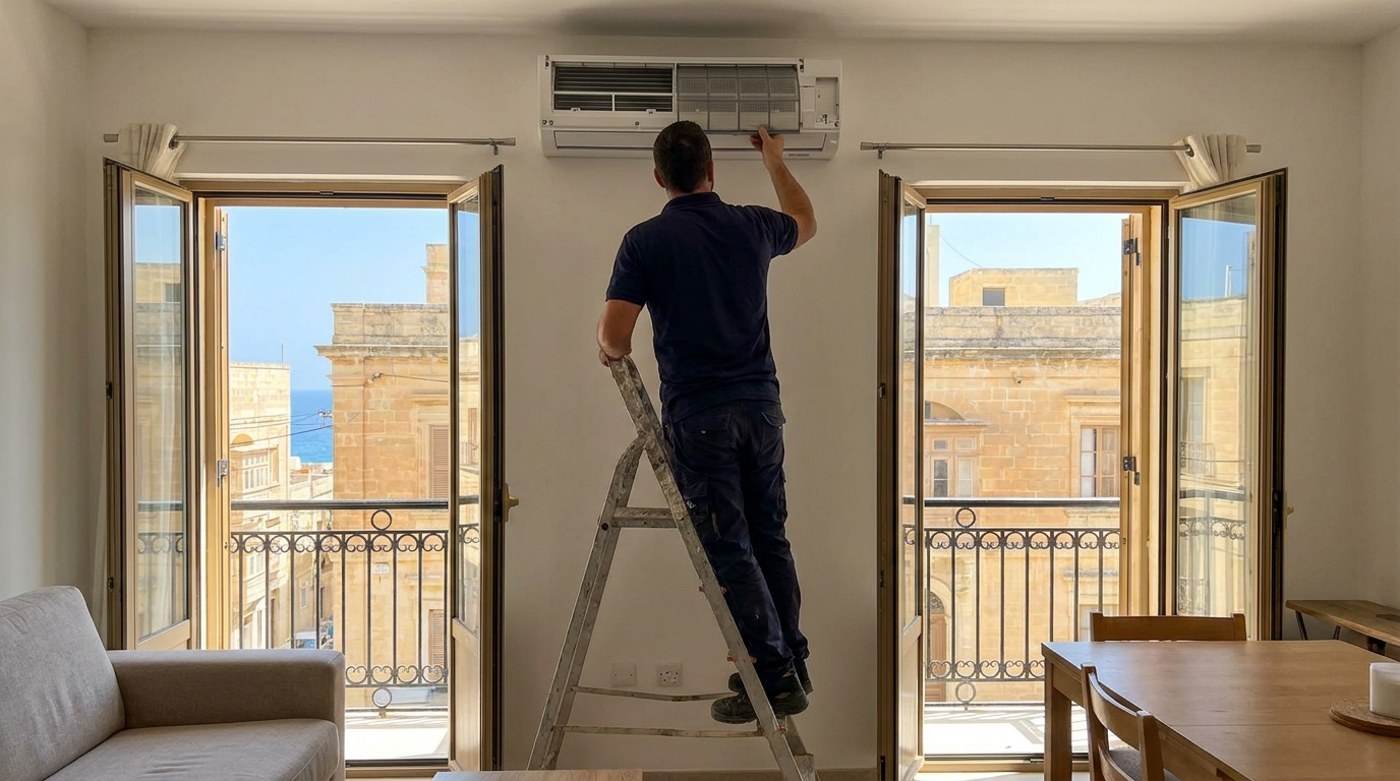
Water indoors is normal — on the outside of the unit, not the inside of the room
Every split system in cooling mode is also a dehumidifier. Warm, damp air passes over a coil that is colder than its dew point, moisture condenses on the fins and runs down into a tray underneath. On a humid September afternoon in Malta a single wall unit can produce litres of water a day. That is the machine working, not failing.
What should happen next is dull: the tray drains into a small pipe, the pipe falls continuously to an outside discharge point, and you never think about it. A leak indoors means that chain has broken somewhere. In the great majority of cases it is a condensate fault, and in most of those it is a blockage.
Stop before you mop
- Switch the unit off at the remote, then at the isolator or breaker if water is running anywhere near the indoor unit's terminals, a socket, a light fitting or a TV below it. The indoor unit is mains-powered and the water is landing on a wall that contains cables.
- Catch the water with a towel or a shallow tray. Do not wedge anything into the unit's louvres.
- Do not restart it to "see if it still does it". If the coil is iced, each restart melts more ice onto your floor.
- Photograph where the water is coming from — the left end of the unit, the right end, behind the casing, or down the wall from the pipe exit. It saves a technician a lot of guessing.
The five things that actually cause it
1. Blocked condensate drain or tray
Dust, hair, kitchen grease and biofilm build up in the tray and the first metre of pipe. In Malta, construction dust and the fine grit that coats everything in summer accelerate this. The pipe outlet outside can also block — spiders, geckos, nesting debris, or a pipe end buried in a planter. Once the tray cannot empty, it overflows at the lowest point of the casing, which is usually one end of the unit.
2. Dirty filters and a frozen coil
Restricted airflow drops the coil temperature until the condensate freezes instead of draining. You get little or no cooling, then a flood when the ice melts. Filters are the single most common cause of this and the one thing you can deal with yourself.
3. A drain pipe that has lost its fall
Condensate moves by gravity. If the pipe sags, was installed close to level, or has been pushed up during other works — a false ceiling, a kitchen fit-out, a neighbour's scaffolding — water pools and backs up. This is an installation fault rather than a maintenance one, and it will come back after every clean until the run is corrected. In shell-form apartments where the drain was chased into the wall before the buyer finished the property, the fall is fixed in concrete and the fix can be intrusive.
4. Low refrigerant
A circuit that has lost charge runs the coil colder than it should and ices it up. The symptom at floor level looks identical to a dirty filter: poor cooling, then water. Anyone opening that circuit to check pressures or recover and recharge refrigerant has to be certified. Regulation (EU) 2024/573 Article 10 requires both the individual and the company to hold certification, and in Malta the certification authority is the MCCAA Technical Regulations Division.
5. Condensate pump failure (mostly ducted and cassette units)
Where gravity drainage is impossible, a small pump lifts the water to a drain. Pumps fail, their float switches jam, and their reservoirs silt up. On a ducted system in a false ceiling the first sign is often a stain on the ceiling board rather than a drip, by which point the plasterboard has been wet for a while.
What a homeowner can safely check
- The filters. Open the front flap, slide them out, wash in lukewarm water, dry fully, refit. If they are grey and furred, you have found at least part of the problem.
- The outdoor end of the drain pipe. Find where it discharges. Is it dripping during operation? If nothing comes out while the unit runs on a humid day, the pipe is blocked.
- Whether the pipe runs downhill for its visible length. Obvious sags or upward kinks are worth photographing.
- Whether the indoor coil has ice on it — visible as white frost on the fins behind the filters.
That is the end of the safe list. Do not pour chemicals down the drain pipe, do not blow into it with an air compressor, and do not open the casing to get at the tray — on most units the tray sits directly beneath live terminals.
The Maltese problem: whose water is it?
In a terraced house the condensate drips into your own yard. In a block it rarely does. Drains are routed to the nearest façade, shaft or back alley, and in practice they drip onto someone else's balcony, washing line, or front door.
Under the Condominium Act, Cap. 398, the external walls, the roof and the airspace of a block are common parts (Art. 2). Article 8(3) requires unanimous consent for alterations that change the aesthetics and decor of the building. The Act says nothing specific about air conditioners, and we are not going to tell you that condominium consent is legally required for a unit — the statute does not say that. What it does tell you is that the surface your condensate is running down is shared property, which is why a dripping drain escalates into a block-wide argument faster than almost anything else. The Act also does not allocate liability for water damage between flats, so if the ceiling below has been stained, that is a civil matter between the parties.
The practical answer is the same either way: fix the discharge. Re-terminating a drain into a proper outlet, or fitting a pump to lift it somewhere sensible, is usually cheaper than the argument.
When a service fixes it and when it does not
A standard clean addresses the two most common causes — filters and a silted tray or drain. Our standard service is €45. If the drain has lost its fall, the pump has failed, or the coil is icing because the refrigerant charge is low, you are into repair work, which is quoted after a survey rather than off a list.
Jobs are surveyed by us. They are then delivered either by us as contractor, with CheckYourTraders-verified, F-gas certified technicians, or by a vetted partner who contracts directly with you — you will know which before anything is booked.
Reducing the odds
- Wash the filters monthly through the cooling season. It is the highest-value ten minutes in the whole system.
- Have the drain cleared as part of a service before summer rather than during it.
- Know where your drain discharges, and check it occasionally.
- If a unit has leaked once and been cleared, and it leaks again the same season, stop assuming it is dirt. Repeat leaks usually mean pipe fall or a pump, and both get worse.
Common questions
- Why is my air conditioner dripping water inside the room?
- In cooling mode the indoor coil condenses moisture out of the air. That water is caught in a tray and should run away through a drain pipe. If the tray or pipe is blocked, the pipe has lost its fall, the filters are dirty enough to ice the coil, or a condensate pump has failed, the water overflows into the room instead.
- Can I keep using the unit while it is leaking?
- No. Switch it off and, if water is running near the indoor unit's electrics, a socket or a light fitting, isolate it at the consumer unit before mopping up. Running a unit with a frozen coil also makes the flooding worse each time it defrosts.
- Will a normal service cure a leak?
- Usually, because most indoor leaks are a blocked drain or dirty filters, and both are dealt with in a standard clean. Our standard service is listed at €45 on the servicing page. If the cause turns out to be a failed pump, a badly fallen drain pipe or ice from low refrigerant, that is a repair job rather than a service.
- My condensate is dripping onto the flat below. Whose problem is it?
- Practically, it is yours to stop, because it is your unit producing the water. Under the Condominium Act the external walls, roof and airspace of the block are common parts, so a drain discharging over a façade or into a shaft is discharging onto something shared. The Act has no clause about air conditioners and does not settle who pays for water damage, so a dispute with the block is a civil matter, not something the statute answers.
- Does water indoors mean the gas has leaked?
- Not by itself. Water is condensate, not refrigerant. But low refrigerant can ice the indoor coil, and the melting ice then overruns the tray — so a leak that keeps coming back after the drain has been cleared is a reason to have the refrigerant circuit checked by a certified technician.
What we could not establish
- The F-gas Regulation sets leak-check duties by charge size in tonnes CO2e (5 t and up). Neither source states the refrigerant charge of a typical domestic split, so we cannot tell you from these sources whether a given home unit falls inside those intervals.
- No Maltese source we can cite publishes where domestic condensate must legally be discharged — into a drain, a soakaway, a downpipe or a planter. Local practice varies and the drainage rules are outside the sources used here.
- Cap. 398 contains no air-conditioning clause at all. It does not say who maintains a condensate pipe crossing a common part, and it does not allocate liability for water damage between flats.
- We have no published figure, Maltese or otherwise, for how often condensate drains block, so nobody can honestly tell you that a given interval between cleans is 'enough'.
Sources
- Regulation (EU) 2024/573 on fluorinated greenhouse gases — EUR-Lex · read 2026-10-18
- Condominium Act, Cap. 398 — legislation.mt · read 2026-10-18
Drafted with Claude — claude-opus-5, then read, corrected and approved by Neil Bennett before publication. We do not publish anything a person has not read.
Want this costed properly?
The calculator gives you a figure in a minute. A site visit gives you a fixed price.
Book a free survey